
For facility managers specifying vehicle access control, the choice between long-range RFID and ANPR (Automatic Number Plate Recognition) is one of the most consequential decisions a site will make. Both technologies enable touchless, automated vehicle identification, but they work differently, suit different site profiles, and have meaningfully different cost and security implications.
This guide sets out what each technology does, compares them directly across the factors that matter most, and explains when to use one, the other, or both.
What is Long-Range RFID for Vehicle Access?
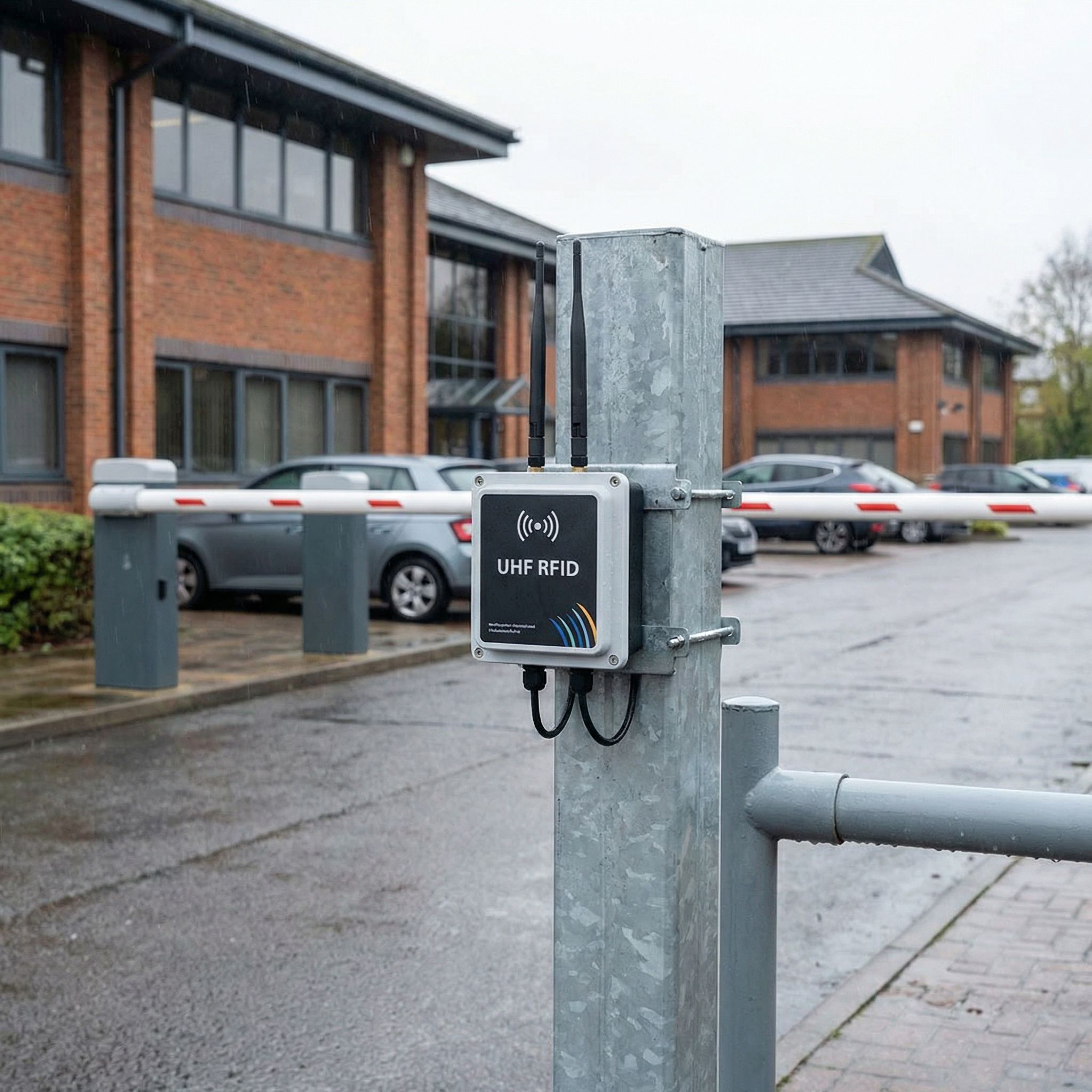
Radio Frequency Identification (RFID) uses electromagnetic fields to identify vehicles automatically. A vehicle access RFID system has three key components: a tag fitted to the vehicle, a reader mounted at the access point, and an access control server that verifies the tag against a database of authorised vehicles.
When a vehicle carrying an RFID tag approaches the reader, the reader transmits a radio signal that powers the tag and reads the unique identifier stored on it. The system cross-references this identifier against the access database. If it matches an authorised vehicle, the barrier or gate opens.
For vehicle access, the two most important RFID frequencies are:
- UHF (860–960 MHz): Offers read ranges of 3–10 metres and is well suited to most commercial access control applications, including gated car parks, business parks and logistics depots. UHF is the technology behind the Nedap uPASS Reach and uPASS Target readers.
- Microwave (2.45 GHz): Provides read ranges up to 15 metres and is designed for demanding applications: fast-moving vehicles, buses, trucks, high-security sites and environments where the UHF frequency could be affected by nearby metalwork. The Nedap Transit Ultimate uses microwave technology.
RFID Tags for Vehicle Identification
RFID vehicle tags are small transponders fitted to the vehicle’s windscreen or chassis. They consist of a microchip (which stores the unique ID), an antenna (which receives and transmits the radio signal) and a substrate or housing.
There are two tag types relevant to vehicle access:
- Passive tags: Powered entirely by the reader’s signal (no battery required). Lower cost, indefinite lifespan, shorter read range. Suitable for most UHF applications.
- Active tags: Battery-powered, capable of longer read ranges and stronger signal in challenging environments. Higher cost, finite battery life. Used in microwave systems and demanding security applications.
Tags can be programmed to authenticate cryptographically, meaning the reader and tag exchange an encrypted handshake rather than simply transmitting a static ID. This encrypted authentication is what makes RFID significantly harder to clone or spoof than a number plate.
What is ANPR and How Does it Work?
Automatic Number Plate Recognition (ANPR) uses an optical camera with specialised imaging and software to read vehicle registration plates as they pass. The system captures an image of the plate, uses optical character recognition (OCR) to extract the registration number, and checks it against an authorised vehicle database. If the plate matches, the barrier opens.
ANPR does not require anything to be fitted to the vehicle. The number plate itself is the credential, which makes it immediately viable for visitor access and any scenario where vehicles cannot have tags pre-installed.
The Nedap ANPR Lumo is an all-in-one unit combining camera, illuminator and license plate recognition engine in a single housing. It operates at ranges of 2–10 metres and integrates directly with access control systems including Nortech’s DeltaQuest controllers.
ANPR accuracy under good conditions is typically 85–98%, with the variation driven by lighting, camera angle, vehicle speed and plate condition. In optimal conditions (good lighting, clean plates, speeds below 30 mph) accuracy approaches 99%. In poor conditions, accuracy drops and missed reads increase.
Long-Range RFID vs ANPR: Head-to-Head Comparison
| Factor | Long-Range RFID | ANPR |
|---|---|---|
| How it identifies vehicles | Encrypted radio tag on vehicle | Optical camera reads number plate |
| Read range | UHF: 3–10m / Microwave: up to 15m | Typically 2–10m |
| Read accuracy | Near 100% within range | 85–98% depending on conditions |
| Weather performance | Unaffected by weather; reads through fog, snow, rain | Affected by heavy rain, snow, direct sunlight, dirty plates |
| Per-vehicle cost | £5–£25 per tag, replaced periodically | No per-vehicle cost |
| Hardware cost | Reader typically lower cost than ANPR camera | Camera higher upfront cost; no ongoing tag cost |
| Visitor access | Not practical (tag must be pre-installed) | Ideal: just register the plate |
| Security level | High (encrypted tag authentication) | Moderate (plates can be cloned or obscured) |
| Vehicle speed | Up to 150+ mph without slowing | Up to ~60 mph for reliable reads |
| Metal near installation | UHF sensitive to metal; microwave is not | Not affected by nearby metal |
| Maintenance | Low (tags are passive, reader needs no cleaning) | Regular camera lens cleaning required |
When to Choose ANPR
ANPR is the better choice when:
- Visitor and contractor access is frequent. Adding a number plate to a database takes seconds. Issuing and managing RFID tags for visitors is impractical at any scale.
- Budget is the primary constraint. ANPR eliminates the ongoing cost of purchasing, fitting and replacing vehicle tags. For sites with large, frequently changing vehicle populations, this saving is material.
- The site is lower-risk. Airports, hospital car parks, business parks with mixed public/staff access and retail parking are well-suited to ANPR. The technology provides effective access control without the overhead of a tag programme.
- Integration with wider surveillance is needed. ANPR cameras can feed data to parking enforcement systems, CCTV platforms and (where legally authorised) law enforcement databases. RFID systems cannot.
ANPR is the primary access technology on most of Nortech’s ANPR-based vehicle access installations at commercial and logistics sites across the UK.
When to Choose Long-Range RFID
Long-range RFID is the better choice when:
- Security is the highest priority. Encrypted RFID tags are significantly harder to defeat than number plates. Cloning a number plate is straightforward; cloning an encrypted RFID credential requires defeating cryptographic authentication. MOD sites, data centres, chemical facilities and high-value logistics operations typically require RFID for this reason.
- Vehicles move fast. UHF RFID reads reliably at speeds up to 150 mph without the vehicle slowing. For bus depots, HGV logistics sites and any application where queuing at a barrier is unacceptable, RFID eliminates the bottleneck.
- Environmental conditions are harsh. RFID is immune to weather, dirt and lighting conditions that degrade ANPR performance. Heavy snowfall, mud-covered plates and industrial environments where cameras need frequent cleaning favour RFID.
- Metal is not a concern (or a microwave reader is used). UHF RFID is sensitive to nearby metal structures. If the installation point is metal-heavy (a steel gate frame, a vehicle with a metal bumper close to the reader), UHF performance degrades. The microwave-based Transit Ultimate is designed for exactly these environments.
- The vehicle population is fixed and known. Fleet operators, employee car parks and transport depots where every vehicle is pre-registered and consistently present are ideal RFID environments.
How Far Does Long-Range RFID Actually Read?
Read range is one of the most searched questions about long-range RFID, and one of the most misunderstood. The answer depends on the specific technology and the installation conditions.
Nortech offers three long-range RFID readers from the Nedap range, each with different read capabilities:
| Reader | Technology | Read Range | Vehicle Speed | Tag Type |
|---|---|---|---|---|
| uPASS Reach | UHF | Up to 6m | Up to 150+ mph | UHF windscreen tag |
| uPASS Target | UHF | Up to 10m | Up to 150+ mph | UHF windscreen tag |
| Transit Ultimate | Microwave | Up to 15m | Up to 150+ mph | Microwave tag |
The key practical difference beyond range is the relationship to metal.
The uPASS Reach and Target use UHF frequencies that can be affected by metal near the installation point. If the reader is mounted on a metal gate post or close to a metal building facade, performance can degrade.
The Transit Ultimate uses a microwave frequency that is not affected by nearby metal, making it the preferred choice for industrial sites where UHF has proved unreliable.
Can You Use RFID and ANPR Together?
Yes. And increasingly, the best solution for many sites is both.
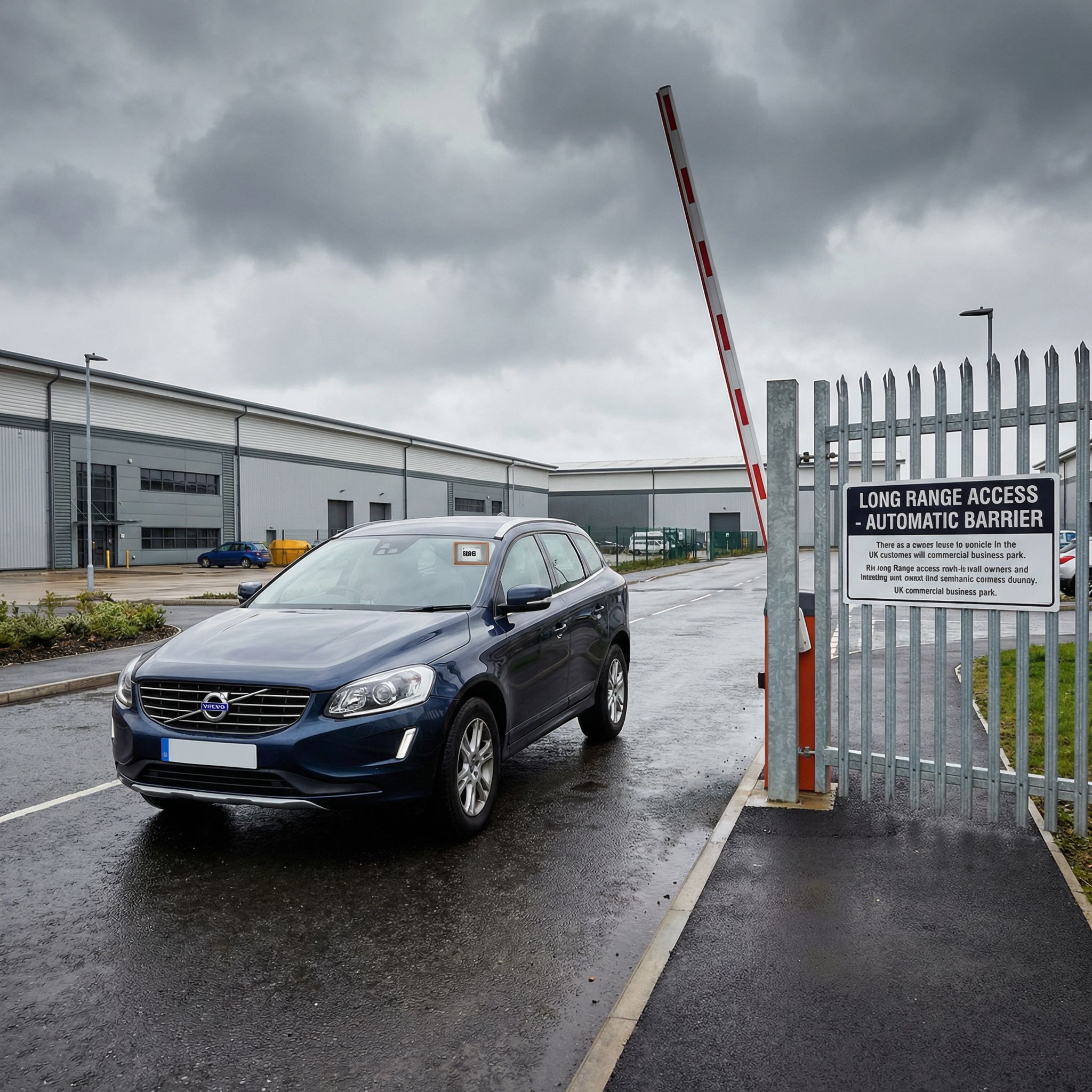
A hybrid deployment uses long-range RFID for regular, authorised vehicles (staff, fleet, contractors) and ANPR for visitors and temporary access. Both systems can integrate with the same access control platform. On a Nortech DeltaQuest installation, for example, both Nedap uPASS RFID readers and the Lumo ANPR camera communicate with the same controller and database.
This approach gives sites the security and speed of RFID for known vehicles, while keeping visitor access frictionless without a tag management programme. It also provides redundancy: if one system experiences a read failure, the other provides a fallback.
Hybrid deployments are particularly common at:
- Large business parks with a mix of staff and visitor traffic
- NHS hospitals with staff car parks (RFID) and public parking (ANPR)
- Logistics depots with both fleet vehicles and visiting delivery contractors
- Industrial facilities where employees use RFID and external contractors use ANPR
Frequently Asked Questions
Which is more secure: RFID or ANPR?
RFID with encrypted tag authentication is more secure. Number plates can be cloned by affixing a false plate to a vehicle, which is a relatively straightforward attack.
Encrypted RFID credentials require defeating the cryptographic handshake between tag and reader, which is substantially harder. For sites where vehicle spoofing is a credible threat, RFID is the preferred technology.
How do costs and maintenance compare between RFID and ANPR?
ANPR cameras typically have a higher upfront cost than RFID readers but no ongoing per-vehicle tag expenditure. RFID systems require purchasing tags (typically £5–£25 each) and periodically replacing them as vehicles change or tags are lost or damaged.
For large, stable vehicle populations, RFID’s total cost of ownership is often comparable to ANPR over five years. For sites with high vehicle turnover, ANPR is usually cheaper in the long term.
What are the main differences between long-range RFID and ANPR?
The fundamental difference is the identification mechanism.
RFID uses a radio tag fitted to the vehicle, so the vehicle is identified regardless of lighting, weather or line of sight. ANPR uses an optical camera to read the number plate, which requires a clean plate, adequate lighting and the vehicle to be oriented correctly.
RFID is faster, more secure and weather-independent. ANPR is more flexible for visitor access and does not require tags.
Which scenarios is each technology best suited for?
RFID is best for high-security, high-speed or harsh-environment applications where all vehicles are known and pre-enrolled. ANPR is best for mixed-use sites with frequent visitor traffic, or where a tag programme is impractical.
Many sites use both simultaneously: RFID for staff and fleet vehicles, ANPR for visitors and contractors.
Can ANPR cameras work in bad weather?
ANPR performance degrades in heavy rain, snow, fog and bright direct sunlight. Mud, snow or damage covering part of a number plate reduces read accuracy significantly. Modern ANPR cameras use infrared illumination to improve low-light performance, but they cannot fully compensate for a plate that is obscured. RFID is unaffected by weather conditions.
How do I choose between the uPASS Reach, uPASS Target and Transit Ultimate?
The choice comes down to required read range, the presence of metal near the installation point and traffic speed. For most standard commercial applications, the uPASS Target (10m, UHF) is sufficient. Where the installation point has significant metalwork nearby, or read ranges beyond 10m are required, the Transit Ultimate (15m, microwave) is the appropriate choice. The uPASS Reach is suited to applications where a shorter read range (up to 6m) is adequate and cost is a consideration.
For a recommendation based on your site’s specific requirements, speak to a Nortech engineer.