
One area within parking management that is easy to overlook is signage: the electronic signs that update in real time to guide drivers and communicate live information. Variable message signs sit at the heart of any modern parking guidance system, yet most guidance on them is either too technical or too surface-level to help buyers make informed decisions.
This guide covers what variable message signs are, how they work, the different types available, where they are used across the UK, and what they typically cost.

What Are Variable Message Signs?
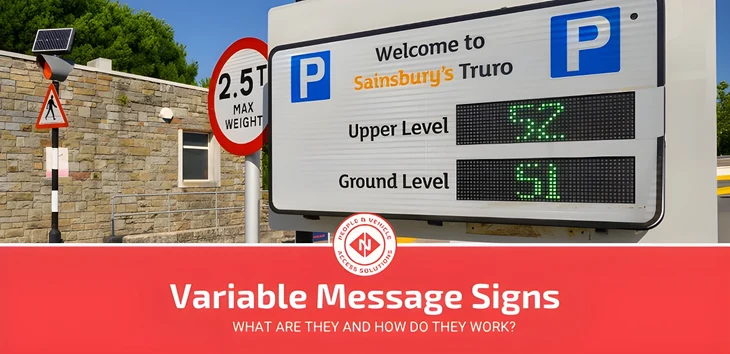
Variable message signs (VMS), also known as dynamic message signs or changeable message signs, are electronic displays that show real-time information to drivers and pedestrians. Unlike static signs with a fixed message, a VMS can be updated remotely and automatically. Depending on the application, it can display available parking spaces, speed limits, lane status or emergency alerts.
A quick note on terminology: in access control and security, “VMS” can also stand for Video Management System. If you are researching camera or CCTV software, you are looking for something different. This guide covers variable message signs used in parking guidance and traffic management.
A Brief History of VMS in the UK
Variable message signs have been used on UK roads since the 1960s. The UK’s first computer-controlled motorway warning system went live on 27 March 1972 on the M6/M62 interchange, introduced by the then Secretary of State for the Environment, Michael Heseltine. Early systems used bulb matrices and rotating prisms to display basic text.
By the 1990s, LED technology had replaced older display methods, bringing significant improvements in energy efficiency, brightness and reliability.
Today, the UK operates one of the most extensive VMS networks in Europe. National Highways manages over 3,000 overhead gantry signs on the strategic road network, while thousands more are deployed in car parks, tunnels, airports and commercial developments across the country.
Types of Variable Message Signs
There are two main categories of VMS, each suited to different applications.
| Type | Power Source | Mounting | Typical Use |
|---|---|---|---|
| Fixed (static) VMS | Mains electricity | Permanently installed on gantry, wall or post | Car parks, motorways, tunnels, airports |
| Portable (moveable) VMS | Battery or solar panel | Trailer-mounted or temporary post | Roadworks, events, temporary diversions |
Fixed VMS are permanently mounted at a specific location and connected to a mains power supply and communication network. They are the standard choice for car park guidance, motorway overhead gantries, tunnel management and any application where ongoing, reliable signage is required. Fixed units are connected to a central management system and can be updated instantly.
Portable VMS are self-contained, trailer-mounted or post-mounted units that can be transported and deployed where needed. They are typically solar or battery powered and communicate via cellular networks. They are widely used for temporary roadworks, event traffic management and emergency diversions, and can be operational within minutes of arrival on site.
Key Components of a VMS Unit
A typical fixed VMS unit consists of:
- LED display panel: The primary visual element, using Light Emitting Diodes to display text, symbols and graphics. Modern LED panels achieve brightness levels of 5,000–10,000 cd/m² for full outdoor visibility, even in direct sunlight.
- Controller: The on-board computer that processes instructions from the central management system and drives the LED panel.
- Communication module: Connects the sign to the management platform via Ethernet, fibre optic, Wi-Fi or cellular network. Allows remote content updates and system health monitoring.
- Power supply: Fixed units are mains-powered; portable units use solar panels, batteries or a combination. Modern LED VMS draw significantly less power than older fibre optic or bulb-based systems.
- Housing and enclosure: The protective casing that shields internal components from weather and impact. Outdoor VMS housings are rated to IP65 as a minimum; high-security or coastal installations may require IP66 or IP67.
- Sensors (optional): Bay detection sensors, vehicle counters, light sensors and temperature monitors can be integrated to trigger automatic content changes based on live conditions.
How Do Variable Message Signs Work?
The operation of a VMS system follows a straightforward sequence:
- Detection: Sensors, vehicle counters or cameras gather real-time data: parking bay occupancy, vehicle speed, traffic density or environmental conditions.
- Processing: Data is sent to a central management system or server, which calculates the appropriate message based on pre-configured rules and thresholds.
- Content generation: The management system generates the correct display content: a space count, speed limit, lane status indicator or text message.
- Transmission: The instruction is sent to the VMS controller via the communication network, typically updating within one to two seconds of a change being detected.
- Display: The LED panel shows the updated message. In a parking guidance system, drivers see live space counts at every decision point, from the car park entrance through to individual bays.
In practice, this means a driver entering a multi-storey car park sees the current number of available spaces on each level before they commit to a floor. When the last space on a level is taken, the sign switches from a green count to a red “FULL” indicator automatically, without any manual intervention.
Variable Message Signs in UK Car Parks
For parking operators and facility managers, the most relevant application of VMS technology is car park guidance: directing drivers to available spaces and reducing the time vehicles spend circulating.
Nortech’s NorParc parking management system integrates directly with VMS displays to provide real-time guidance across multi-zone car parks. Bay detection sensors communicate occupancy data to the NorParc server, which updates the VMS signs at each entry point, floor transition and junction throughout the facility.
A well-configured parking guidance system using VMS typically delivers:
- A reduction in circulating traffic of 30–40%, as drivers go directly to available spaces rather than searching
- Reduced emissions from circulating vehicles
- Improved driver experience, particularly in complex multi-storey environments
- Operational data on peak occupancy periods and dwell times for management reporting
Colour Conventions for Car Park VMS
Most car park guidance VMS in the UK follows a consistent colour convention:
- Green: Spaces available (often displayed with a numeric count)
- Red: Level or zone full (no spaces available)
- Amber/Yellow: Limited spaces remaining (typically fewer than 10% of capacity)
- White or blue: Directional arrows and wayfinding
This colour coding is not mandated by legislation for private car parks, but is industry-standard practice and what drivers expect.
Variable Message Signs in UK Roads and Highways
On the UK strategic road network, motorway variable message signs are operated by National Highways and regulated under the Traffic Signs Regulations and General Directions (TSRGD) 2016. Motorway overhead VMS on gantries can display:
- Variable speed limits (enforced on Smart Motorways)
- Lane closure signals (red X)
- Congestion, incident and roadwork warnings
- Journey time information
- Emergency messaging including National Emergency Alerts
Smart Motorways, where the hard shoulder is managed as a running lane, rely entirely on overhead gantry VMS for lane control. Every gantry sign must update within a defined response time from the National Highways Regional Control Centre.
Local authorities also operate VMS for urban traffic management, covering car park availability, event diversion routes and travel times. The standard governing VMS reflectivity and visibility on UK public roads is BS EN 12966.
How Much Do Variable Message Signs Cost?
Pricing for VMS varies considerably depending on display size, specification, communication infrastructure and installation complexity. The following ranges are typical for UK commercial projects:
| Application | Unit Cost (supply only) | Installed System Cost |
|---|---|---|
| Small car park bay-count sign (single zone) | £800–£1,500 | £2,000–£5,000 |
| Multi-zone car park guidance sign | £1,500–£3,000 | £4,000–£10,000 per sign |
| Full parking guidance system (100 spaces) | N/A | £15,000–£50,000 |
| Full parking guidance system (500+ spaces) | N/A | £50,000–£150,000+ |
| Portable roadworks VMS trailer | £5,000–£15,000 | Hire from £150/week |
| Motorway overhead gantry VMS | £30,000–£80,000 | Part of wider infrastructure project |
These are market ranges, not Nortech list prices. The total cost of a car park guidance project is driven by the number of zones, the level of bay-by-bay detection required, cabling runs and integration with existing access control or parking management software.
For a tailored quote based on your specific site, speak to a Nortech engineer.
Industries That Use Variable Message Signs
VMS technology is deployed across a wide range of UK sectors:
- Car parks: Multi-storey, surface, airport and hospital car parks all use VMS-based guidance to reduce congestion and improve the driver experience.
- Highways and roads: National Highways, Transport for London and local authorities use VMS for traffic management, speed enforcement and incident notification.
- Tunnels: Road and rail tunnels use VMS for lane control, speed limits and emergency messaging, often with strict response-time requirements.
- Airports: VMS guides vehicles throughout airport environments, from terminal car parks to landside road networks.
- Stadiums and event venues: Large venues deploy portable and fixed VMS to manage the surge of vehicles during events and direct drivers to available parking zones.
- Healthcare: NHS hospital sites use VMS to guide patients and visitors to available parking, improving access and reducing stress for people attending appointments.
- Logistics and distribution: Warehouse and depot operators use VMS for yard management, directing HGVs to loading bays and controlling traffic flow within large sites.
Frequently Asked Questions
What is the difference between a VMS and a static road sign?
A static sign displays a fixed message that cannot change without physical replacement. A variable message sign uses an electronic LED display that can be updated remotely in real time. It can show space counts, speed limits, incident warnings or directional information depending on current conditions.
What does VMS stand for in parking?
In parking and traffic management, VMS stands for Variable Message Sign. Note that in security and access control, VMS can also stand for Video Management System, which is software used to manage IP cameras and CCTV. These are entirely different technologies.
How long do variable message signs last?
Modern LED-based VMS units have a typical operational lifespan of 10–15 years with routine maintenance. LED panels degrade gradually in brightness over time rather than failing suddenly, and individual LED modules can be replaced without replacing the whole sign.
Do variable message signs need planning permission in the UK?
Roadside VMS on public highways are subject to the Highways Act and require approval from the relevant highway authority.
VMS within private car parks (such as parking guidance signs inside a multi-storey) are generally treated as internal signage and do not require planning permission. Always confirm requirements with your local planning authority, as rules vary by authority and installation type.
What communication protocol do VMS systems use?
Most modern VMS systems support NTCIP (National Transportation Communications for ITS Protocol), the international standard for interoperability between traffic management systems.
Car park VMS typically communicates over Ethernet, fibre optic or cellular (4G/5G LTE) networks. Integration with parking management software is via API or NTCIP-compliant controllers.
How are car park VMS signs connected to parking bay sensors?
Bay-level sensors (typically ultrasonic or infrared detectors mounted above each space) send occupancy signals to zone controllers, which aggregate the data and pass it to the central parking management server. The server calculates real-time counts for each zone and pushes updates to the VMS displays. The full cycle from a space changing status to the sign updating typically takes one to three seconds.