
Securing the front reception door of a multi-tenant office, hotel or hospital only solves half the problem.
Once a visitor, contractor or delivery driver steps past reception into a lift, an unrestricted car gives them silent access to every floor in the building—server rooms, private clinics, executive suites and guest bedrooms alike.
A lift access control system (often searched as an elevator access control system) connects your building’s access credentials directly to the lifts so every card, fob or mobile pass unlocks only the specific floors that person is authorised to visit.
From our engineering base in Cwmbran, South Wales, Nortech has supplied floor-by-floor lift controllers and concealed panel readers to UK installers for decades.
This guide explains the three ways to secure a lift, how relay-based floor control wires into an existing car without invalidating the lift warranty, UK fire-alarm rules, and realistic 2026 UK installation prices.
How Does Lift Access Control Work?
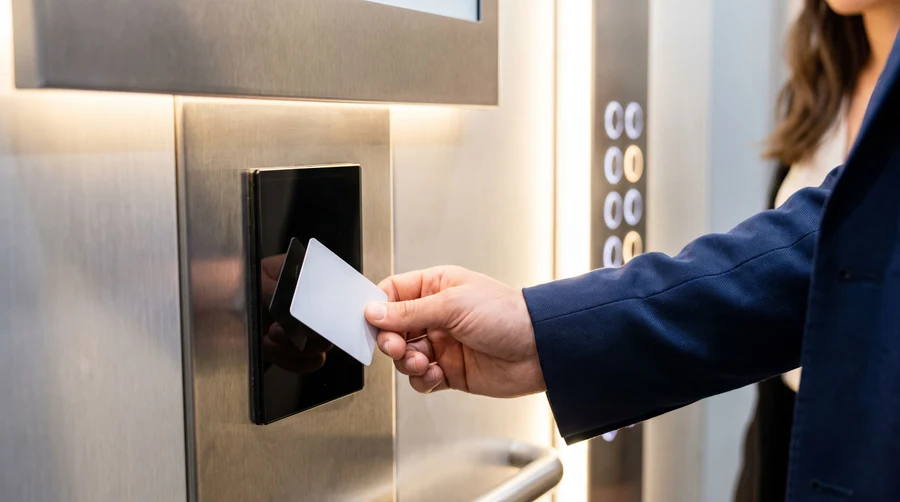
In a standard floor-by-floor lift access control system, a user steps into the lift car and presents their access card or fob to a reader fitted inside the car operating panel (COP). The access controller checks the credential’s permissions and closes dry relay contacts wired to that user’s authorised floor buttons for a preset strike time—leaving every other floor button unresponsive.
The lift’s own motor drive, door operators and safety circuits remain completely separate from the access control system.
All the access controller does is act as an authorised switch in series (or parallel) with each floor button.
Here is the exact sequence inside a lift car configured to our AN-0506 Lift Integration guide:
- Card presented in the lift car. The user taps their card or fob against the concealed reader on the car operating panel.
- Parallel data read. The reader’s Wiegand or Clock & Data lines run in parallel to every floor controller assigned to that lift car, so every panel sees the same credential simultaneously.
- Authorised floor relays energise. Each controller checks the card’s access level and closes the relay for every floor that user is permitted to visit (while public floors such as ground-floor reception remain free at all times).
- User selects a floor. The passenger presses an enabled floor button within the configured strike time—set in Norpass3 up to
240 secondsbased on the lift manufacturer’s guidance. - Buttons re-lock automatically. Once the strike window expires, all relays return to their locked state until the next valid credential is presented.
Because each floor is simply treated as a door inside Norpass3, one credential opens the building entrance, the tenant’s office doors and their specific lift floors with no extra cards to carry.
If you are still planning the wider building architecture around your lifts, start with our explainer on what access control is and how networked systems work.
Three Ways to Control Lift Access (Plus Destination Dispatch)
Not every building needs wires spliced into every lift floor button. Depending on your floor plan, budget and whether your lifts are older relay-controlled cars or modern destination-dispatch systems, there are four architectures to weigh up.
| Method | What It Controls | Typical Wiring / Integration | Best For | Key Limitation |
|---|---|---|---|---|
| Lift lobby doors | Entry from the lift lobby into each floor’s workspace | Standard door reader + lock on each floor’s lobby door, with free exit back to the lift | Multi-tenant offices where every floor already has a secure lobby door | Anyone can still ride the lift and reach the lobby outside a tenant’s door |
| Lift call button | Who can summon the lift from the landing | Reader replaces or enables the landing call button via a controller relay | Warehouses, private penthouses or buildings where lift use itself is restricted | Once inside the car, passengers can press any floor |
| Individual floor buttons (hardware relays) | Exact floor buttons enabled inside the lift car | Concealed car reader + controller relays wired to each floor button (≤ 30 V) | Hotels, multi-tenant blocks, hospitals and retrofits on existing lifts | Requires lift-company attendance to wire the travelling cable and COP |
| Destination dispatch (high-level IP) | Hallway kiosk assigns a lift car directly to the user’s floor | Software/IP API interface directly into Otis, KONE, Schindler or TK Elevator controllers | High-rise new builds (15+ floors) with heavy peak-hour lobby traffic | Higher upfront licence cost and manufacturer lock-in |
In practice, many UK commercial sites combine two methods—for example, hardware floor-button control inside the lift cars paired with card readers on the lobby doors of high-security finance or IT floors.
When Lobby Doors Beat Car-Button Wiring
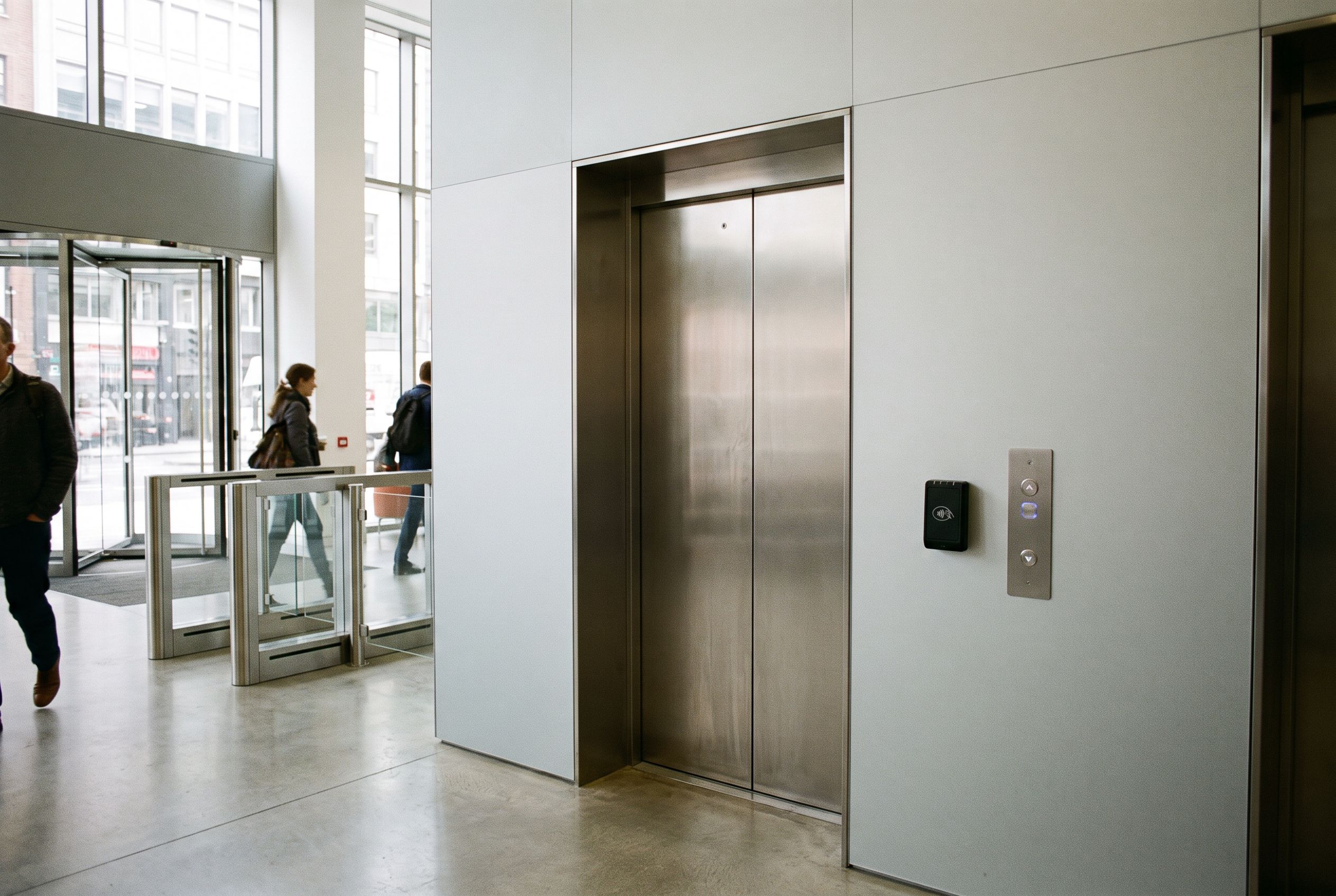
If every floor already has a solid fire-rated lobby door separating the lift landing from the tenant suite, putting standard card readers on those lobby doors is often faster and cheaper than touching the lift shaft.
You avoid lift-company callout charges, avoid running fresh cores down the lift’s travelling cable, and gain full door-forced and door-held monitoring on every floor.
Conversely, in hotels, residential blocks or open-plan offices where the lift doors open directly onto guest corridors or reception desks, individual floor-button control inside the car is the only clean way to keep unauthorised visitors off private floors.
Retrofit Hardware and Wiring: What Installers Need to Know
Retrofitting floor-by-floor access control onto an existing UK passenger lift requires two trades working together: the security installer (supplying and programming the access control) and the building’s lift maintenance company (making physical connections inside the lift shaft, car and controller cabinet).
Before ordering hardware, check five datasheet limits with the lift engineer on site.
1. Sizing Controllers by Floor Count
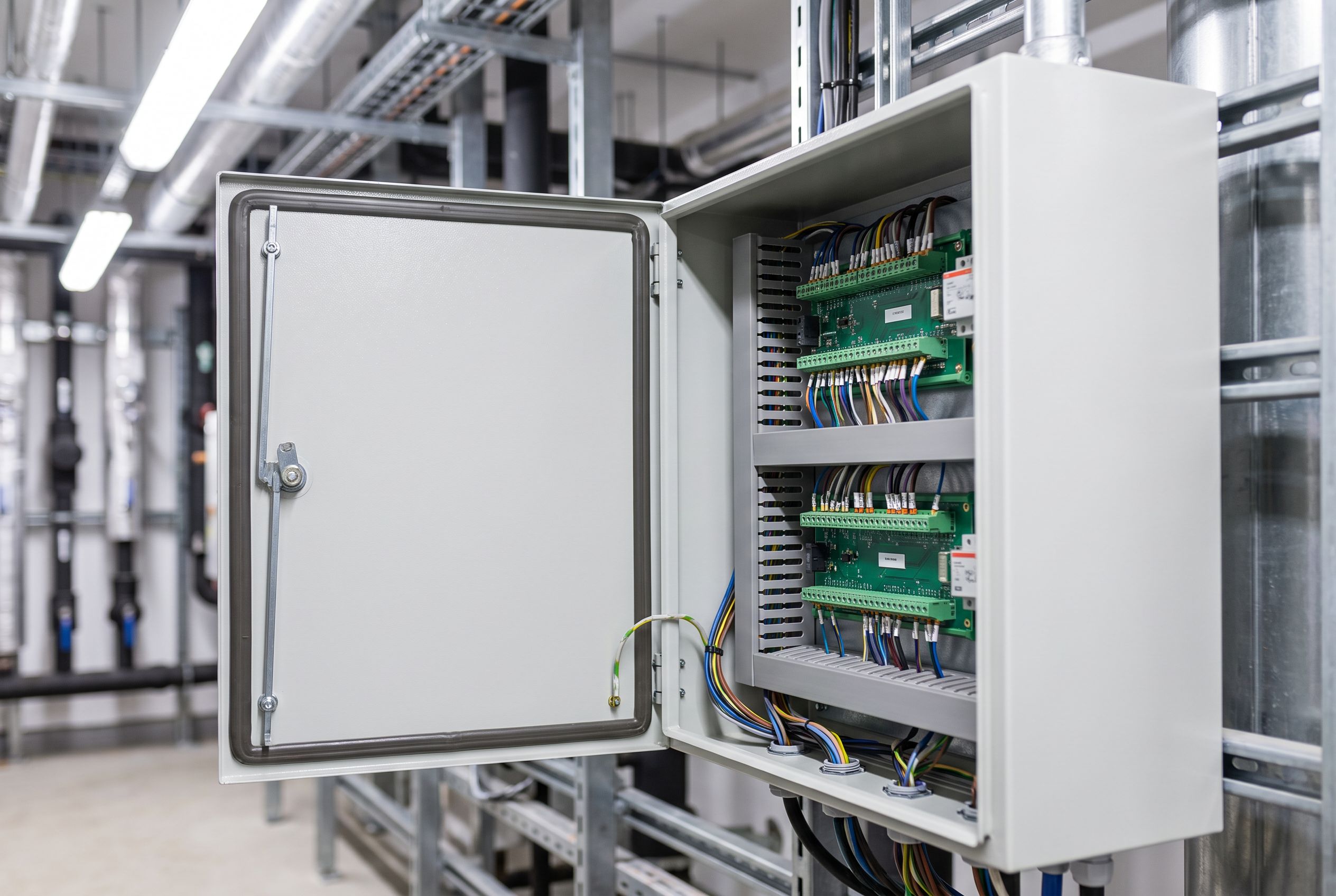
Under Nortech’s AN-0506 lift architecture, each two-door controller module switches up to two floor buttons.
One boxed CRC220-4 four-door controller—which houses two CRC220 modules and an integral 12 V 3 A power supply inside a 330 × 300 × 105 mm metal enclosure—therefore controls up to 4 restricted floors per lift car.
- Up to 4 restricted floors: 1 ×
CRC220-4enclosure per lift car - 5–8 restricted floors: 2 ×
CRC220-4enclosures wired in parallel per lift car - 9–12 restricted floors: 3 ×
CRC220-4enclosures wired in parallel per lift car
Public floors that never require a card (such as ground floor or basement car park) do not consume a relay channel, so a 6-storey office with an open ground floor only needs 5 controlled relays.
2. Choosing the Right Car Operating Panel Reader
Surface-mounting a bulky mullion reader on a brushed stainless-steel lift panel looks untidy and invites knocks from luggage trolleys and cages.
Our PP1 Panel-Mount Reader is designed specifically to sit concealed behind lift operating panels and stainless-steel intercom faceplates:
- Footprint:
55 × 55 × 16 mmwith standard48 mmmounting hole centres - Environmental rating:
IP66sealed ABS module (-30°C to +50°C) with a 5-year manufacturer warranty - Read range & formats: Up to
50 mmdepending on credential, supporting125 kHzEM/Paxton (PP1-EM1) or DualProx PAC + EM (PP1-DP1) over Wiegand, Clock & Data or RS232
If your building already runs encrypted 13.56 MHz MIFARE DESFire credentials, you can wire any Wiegand or Clock & Data smart card reader using the exact same parallel data-line layout—see our breakdown of how smart card readers work when choosing between proximity and DESFire.
3. Five Electrical Rules to Agree with the Lift Company
Never let a security technician open a lift controller cabinet without the contracted lift engineer present—doing so can breach maintenance contracts and UK LOLER 1998 inspection compliance.
Agree these five technical details at the pre-start survey:
- Button circuit voltage: Must not exceed
30 V DC(CRC220 latch relay contacts are rated2 A at 30 V DC). If the lift uses higher-voltage call circuits, interposing relays are required. - Contact polarity: Normally open (NO) floor buttons wire in series with the controller’s NO relay contacts; normally closed (NC) buttons wire in parallel with NC contacts.
- Travelling cable spares: Confirm how many screened cores are free in the lift’s existing travelling cable for reader power (
12 V DC,70 mAmax on PP1) and Wiegand/Clock & Data lines (within100 mon Belden 9536 or equivalent). - Single power source for parallel controllers: Where multiple CRC220-4 panels share one car reader, connect data lines and
0 Vcommon to every controller, but power the reader from one controller only to avoid earth loops. - Strike time and free-floor schedules: Confirm how long the lift controller needs a button enabled after a card tap, and set daytime open-floor schedules (such as reception hours) via Norpass3 time periods (application note AN-05023).
Fire Alarm and Emergency Compliance in UK Lifts
Fire safety is where poorly designed lift integrations fail building control sign-off. In UK commercial and residential buildings governed by Approved Document B and BS EN 81-73, the lift’s own fire-recall circuit must always take priority over access control.
Under Nortech application note AN-0506, every floor-button lift controller must have its Fire Input Action set to No Action.
That sounds counter-intuitive if you are used to fail-safe magnetic locks on corridor doors, where a fire alarm drops power to unlock every door immediately.
On a lift floor-button circuit, energising every floor relay during a fire would achieve nothing useful—passengers should not be using standard passenger lifts during a fire evacuation, and the lift’s own BS EN 81-73 recall circuit automatically overrides car buttons and sends the car to the designated fire-exit floor with doors open.
On the lobby-door method, standard UK fire safety rules apply as normal: the door controllers’ fire-alarm input releases all magnetic locks so anyone exiting a lift into a lobby can evacuate freely towards the fire stairs.
For dedicated firefighter lifts (BS EN 81-72), the lift’s firefighter key-switch mode bypasses car access control entirely so emergency crews always have full floor-by-floor command.
How Much Does Lift Access Control Cost in the UK? (2026)
A typical UK floor-by-floor retrofit on a single 4-floor lift car costs between £1,200 and £2,800 installed (excluding VAT), depending on whether you already run a networked access control system and how much lift-company attendance is required. For broader building pricing across standard doors, see our UK access control system cost guide.
| Cost Element | Typical UK Cost (ex VAT) | What Drives the Price |
|---|---|---|
| 4-floor controller panel (e.g. CRC220-4 with PSU) | £350 – £600 per 4 floors | Stack one panel per 4 restricted floors per lift car; add TCP/IP-220 module if linking over LAN |
| Concealed lift car reader (e.g. PP1 panel-mount) | £90 – £220 per lift car | 125 kHz proximity sits at the lower end; MIFARE DESFire or multi-tech QR/mobile readers sit higher |
| Security installer labour & commissioning | £450 – £900 per lift car | Mounting panels in the motor room/riser, programming Norpass3 access levels and testing |
| Lift-company engineer attendance | £400 – £1,200 per lift car | Mandatory for shaft access, travelling-cable termination and COP button-circuit wiring |
| Management software licence | £0 (Norpass3) to £1,500+ | Nortech’s Norpass3 is licence-free; enterprise OEM lift APIs often charge per-car annual licences |
One cost trap catches facilities managers out repeatedly: destination-dispatch software licences.
Some major lift OEMs charge several thousand pounds per car—plus recurring annual maintenance fees—just to unlock their high-level IP protocol.
For buildings under 12 floors, hardware relay floor control using licence-free software such as Norpass3 delivers the exact same card-to-floor security at a fraction of the lifetime cost, and lets you issue standard key fobs or proximity cards across doors and lifts alike.
Frequently Asked Questions
What is lift access control?
Lift access control (also called elevator access control) links a building’s card, fob or mobile access system to its lifts so each person can only travel to authorised floors. It operates by securing lift lobby doors, enabling landing call buttons, or wiring controller relays into individual floor buttons inside the lift car.
How much does an elevator card access system cost in the UK?
In the UK, retrofitting floor-by-floor card access onto a single 4-floor lift car typically costs £1,200 to £2,800 (ex VAT), including access controllers, a concealed car reader, security commissioning and lift-company attendance. Each additional block of 4 restricted floors adds roughly £350 to £650 in controller hardware plus lift-engineer termination time.
Can lift access control be retrofitted to an existing lift?
Yes—hardware relay integration works with almost any existing lift whose floor-button circuits operate at 30 V DC or below, without modifying the lift’s own drive controller. Your security installer supplies the access panels and car reader, while your lift maintenance company connects the travelling cable and floor-button relays.
What happens to lift access control during a fire alarm?
On floor-button lift systems, access controllers are configured with Fire Input Action set to No Action so an alarm never enables restricted floors. Instead, the lift’s own BS EN 81-73 fire-recall circuit takes priority, homing the car to the ground exit floor and opening the doors automatically.
Does lift access control still work if the network goes down?
Yes, provided your controllers store cardholder databases locally. Nortech CRC220-4 lift controllers hold up to 65,000 sequential cards (8,000 random) and 1,700 events in onboard memory, so once programmed in Norpass3 they continue validating cards and enabling authorised floors offline even if the building network or server PC goes down.
Getting lift security right comes down to choosing the simplest method for your floor layout—lobby doors, call-button control or car-panel relays—and agreeing button voltages, travelling cables and fire recall with the lift company before work starts.
If you are planning a multi-tenant office, hotel or hospital lift retrofit, talk to a Nortech engineer in Cwmbran—we can share application note AN-0506 and map out the exact CRC220-4 controller count and reader specification for your lift cars.